# 11: A fragrant potpourri of news
Hello, and welcome to the latest instalment of Textual Healing! No unifying theme this time, so read on for a mishmash of bits and bobs, odds and ends, a sumptuous blend of news, recommendations, updates, and so on!
GMC on CNN
A few months ago we were contacted out of the blue by a CNN journalist who was looking into the impact of AI on the translation industry. Never known to turn down an AI-bashing opportunity, we jumped at the chance, and CNN ended up interviewing our very own Timothy – partly on his own behalf and partly on GMC's – alongside other translators and language professionals.
Needless to say it paints a pretty gloomy picture, but it's very heartening to see our plight featured in mainstream media, especially with Timothy's AI-critical pull quote in the headline. 👇 Read the story here 👇
 Lianne Kolirin
GMC, live and direct 🎤
We're going on tour again, this time to Belgium, to the University of Liège where we've been invited to speak at the Traductologie de Plein Champ conference on the 12 and 13 May. Our talk will be entitled "Navigating Precarity: Innovative Governance and Feminist Economics for Language Workers", though we're planning to get a lot of AI talk in there alongside the governance and economics side of things.
Since this is a smaller event than last summer's EST Congress in Leeds, we'll be able to speak for longer than before and enjoy a Q&A session alongside some of the other participants. And it won't be a solo affair: Timothy and Alex will be presenting together.
This will get a full writeup in due course, but in case you missed our last in-person shindig, here's the article on our Leeds talk, which includes a "director's cut" video of the presentation.
 Alex Minshall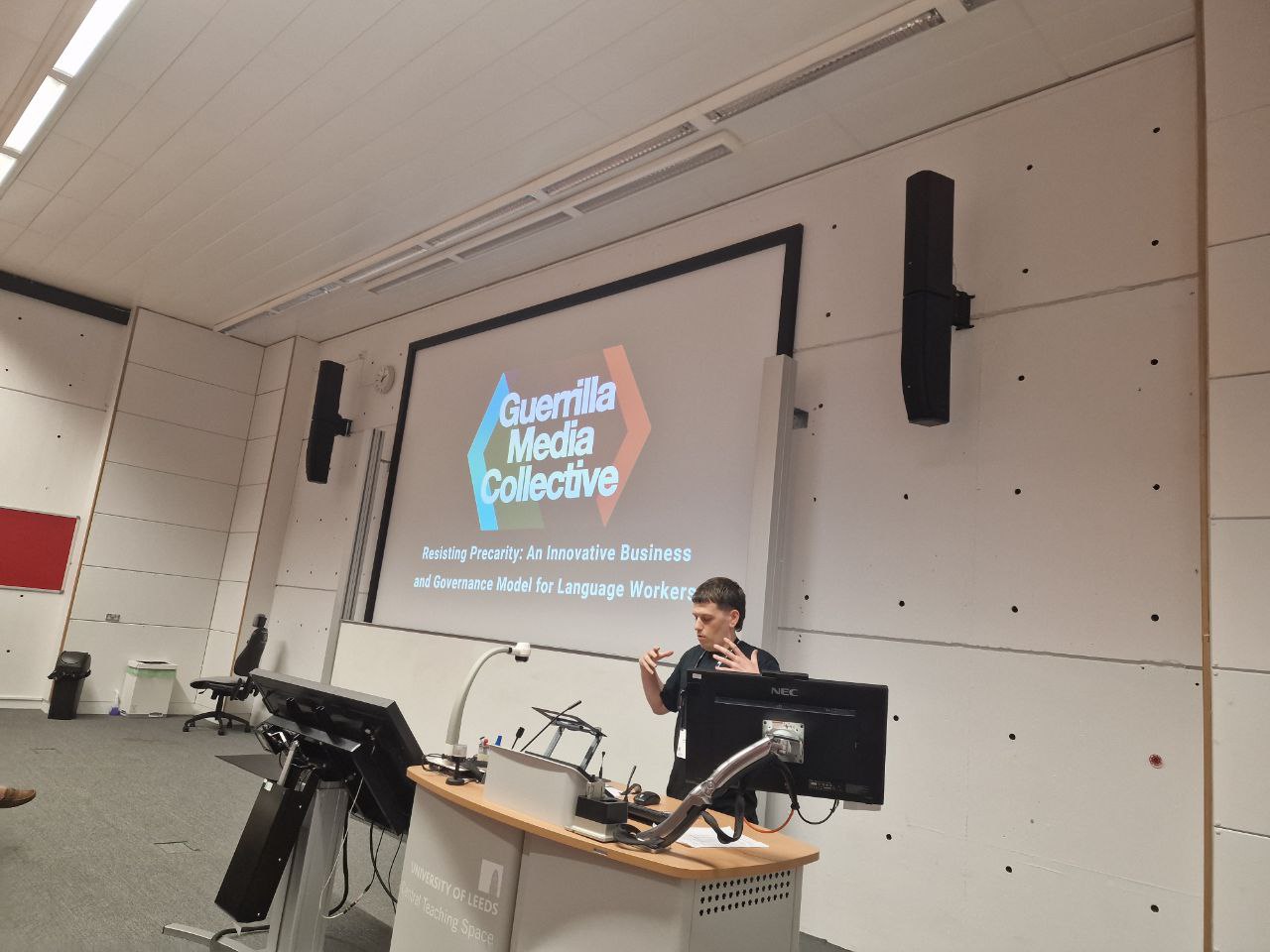
We've also had an assortment of agency work. Some of it's still ongoing, but without being exhaustive:
- We translated, among other things, an article for the Rosa Luxemburg Foundation on last week's French local elections
- Our Spanish translation of Lynn Murphy and Alnoor Ladha's 2022 book Postcapitalist Philanthropy is now scheduled for launch. It's published by Daraja Press
- We did English subtitles for Cooperacció's documentary "Ecos de la terra", which features interviews with ecofeminist leaders from around the world.
Cool stuff from friends!
Last but not least, we've been diving into a couple of really interesting texts published by friends of the collective.
The Data Worker's Inquiry, spearheaded by Milagros Miceli, has been doing the good work of uncovering the human labour that underpins supposedly "artificial" intelligence. We participated in the Inquiry on behalf of the translation industry last year, and the project continues to put out damning articles from the workers who make the whole system keep running.
In this instalment, anonymous workers in France reveal the bizarre pressure of impersonating a chatbot for Outlier, an AI-training company that's really more of a glorified mechanical Turk. Workers are explicitly tasked with chatting online to people who believe they're talking to an AI system, and have to sound "natural" at all costs. They are told in no uncertain terms when signing up for this work that "Human involvement must not be disclosed. Users must believe the system is autonomous".
What a time to be alive.

The Encounters in Translation journal is always a source of fascination, inspiration and solidarity for our industry.
The journal recently published an article by Alaa Alqaisi, a Palestinian writer, translator and researcher from Gaza, and it's a standout. It's a deep exploration of what it means to translate under a genocide, and as part of a culture under permanent threat of eradication. Rather fittingly, it's been translated into 16 languages, all of which are available at this link alongside the original English 👇
 Alqaisi, Alaa